Overview
The Engine Gateway provides a RESTful interface to interact with process engines, automatically routing requests to the appropriate BPMN engine based on the process definition and the configured engines.
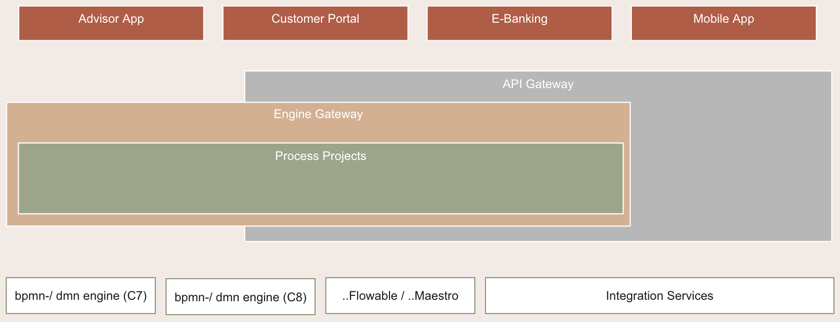
Features
- RESTful API: Clean HTTP endpoints for all process operations
- Automatic Engine Routing: Gateway automatically selects the right engine (for now C7 and/or C8)
- OpenAPI Documentation: Full API documentation
- Type-Safe: Leverages Scala 3 and Tapir for compile-time safety
- ZIO Integration: Built on ZIO for composable, type-safe effects
- Bearer Token Authentication: Secure token-based authentication with pass-through to the engines REST API.
- Identity Correlation: JWT-based user identity extraction for process security
- Domain Driven: The API leverages the Domain Driven nature of Orchescala. Meaning the bodies represent the Domain Objects - In-/Out-Objects of the process interactions.
Architecture
The Gateway module is built on three main components:
1. GatewayServer
The GatewayServer is an abstract class that extends EngineApp and ZIOAppDefault. It provides the HTTP server infrastructure and combines all route handlers.
import orchescala.gateway.*
import orchescala.engine.*
import orchescala.worker.*
import zio.*

abstract class MyGatewayApp extends GatewayServer:
  def config: GatewayConfig = DefaultGatewayConfig(
    engineConfig = DefaultEngineConfig(),
    workerConfig = DefaultWorkerConfig(DefaultEngineConfig()),
    gatewayPort = 8888
)2. GatewayConfig
The GatewayConfig trait defines the configuration interface for the gateway:
engineConfig: EngineConfig- Engine configuration (tenantId, parallelism, etc.)workerConfig: WorkerConfig- Worker configuration for init worker patterngatewayPort: Int- HTTP server port (default: 8888)validateToken(token: String)- Custom token validation logicextractCorrelation(token: String, in: JsonObject)- Extract identity correlation from JWT
The DefaultGatewayConfig provides a basic implementation with JWT-based token extraction.
3. Route Handlers
The gateway provides five main route handlers:
- ProcessInstanceRoutes: Starting processes and querying instances
- UserTaskRoutes: Getting task variables and completing tasks
- WorkerRoutes: Triggering workers via gateway
- MessageRoutes: Sending messages to processes
- SignalRoutes: Broadcasting signals
Getting Started
Basic Setup
import orchescala.gateway.*
import orchescala.engine.*
import orchescala.worker.*
import zio.*

object MyGatewayApp extends GatewayServer:

  def config: GatewayConfig = DefaultGatewayConfig(
    engineConfig = DefaultEngineConfig(),
    workerConfig = DefaultWorkerConfig(DefaultEngineConfig()),
    gatewayPort = 8888
)OpenAPI Documentation
The gateway automatically generates and serves OpenAPI documentation:
- HTML Documentation:
http://localhost:8888/docs - OpenAPI YAML:
http://localhost:8888/docs/openapi.yml
Next Steps
- Authentication & Security - Learn about token validation and identity correlation
- Impersonation - Understand identity correlation and process security
- BPMN Engine Support - Supported engines, routing, and worker forwarding
- Demo Company - Check out an Example, on how to set up different BPMN-Engines.